Legal AI
Arabic-first legal AI for GCC law firms and legal teams
Qanu is a bilingual legal workspace, not a chatbot. Research laws and regulations with citations, work on matter documents, and collaborate in Arabic and English in one place.

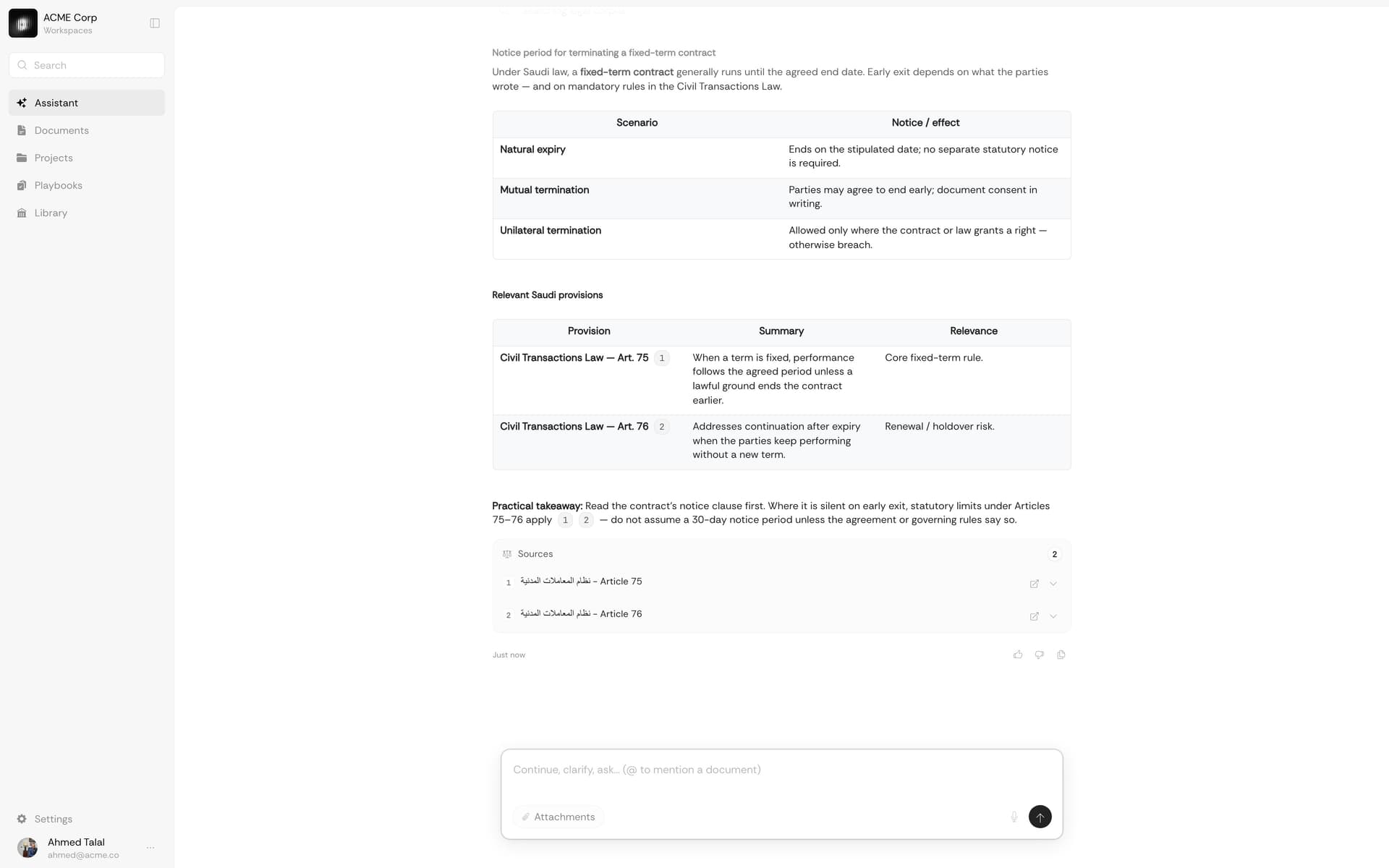
What legal AI means here
A workspace for matter work, not a chat window
General chatbots answer a question and move on. Legal AI in Qanu sits inside your matters: it reads your documents, cites the sources it relied on, and keeps the work reviewable by your team.
| What legal AI means here | General-purpose chatbot | Qanu legal workspace |
|---|---|---|
| Sources | General-purpose chatbot: Answers without sources you can verify | Qanu legal workspace: Every answer links to the law, regulation, or matter document it relied on |
| Context | General-purpose chatbot: Knows nothing about your matter | Qanu legal workspace: Works inside the matter, with its documents, notes, and history |
| Language | General-purpose chatbot: English-first, often loose with Arabic legal terminology | Qanu legal workspace: Native Arabic and English, including GCC legal terminology |
| Team | General-purpose chatbot: One person, one chat | Qanu legal workspace: Shared projects, permissions, and review across the team |
| Data | General-purpose chatbot: Prompts may be used to train the model | Qanu legal workspace: No training on your content, with in-country hosting in KSA and the UAE |
Who it's for
Built for law firms and in-house legal teams across the GCC
Qanu is for lawyers who are accountable for the answer. It is not a legal Q&A app for the public.
Law firms
Partners and associates running Arabic and English matters across Saudi Arabia, the UAE, and the wider GCC. Research, draft, and review with citations your clients can check.
Qanu for law firmsIn-house legal teams
General counsel and legal departments handling contracts, regulatory questions, and outside counsel, in one shared workspace instead of scattered files and chats.
Qanu for general counselGovernment and regulated entities
Legal teams that need data to stay in-country or inside their own cloud, with encryption keys they control.
GCC data protection laws for legal teamsArabic and English
Both languages in the same matter
GCC legal work rarely happens in one language. The law is in Arabic, the client memo may be in English, and the contract is often both.
Ask in either language
Ask in Arabic or English and get answers grounded in laws and regulations, with citations you can open and verify.
Bilingual documents
Keep the Arabic and English versions of a document in the same matter, with the same permissions and version history.
Right-to-left done properly
Arabic text, numbering, and citations render right-to-left across chat, documents, and the editor.
Alongside global tools
Works next to Harvey and Legora
Many GCC firms already use Harvey or Legora for English work tied to DIFC or London. Qanu doesn't ask you to replace them. It covers the Arabic and bilingual GCC matter work those tools weren't built for.
Explore the workspace
Where legal AI shows up in Qanu
- Explore chat
Legal chat
Multi-step legal research with citations across laws, regulations, and your matter files.
- Explore documents
Documents
Store, permission, and version matter files in Arabic and English.
- Explore the library
Legal library
Search official legal sources with clear provenance on every result.
- Review security
Security
Encryption, in-country hosting, BYOK, and deployment in your own cloud.
Free bilingual contract templates
Word and PDF drafts for GCC law firms and in-house legal teams, in Arabic and English, with drafting notes and links to official sources. They are templates, not legal advice.
GCC contract templates in Arabic and EnglishFAQ
Legal AI questions
What is legal AI?
Legal AI is software that uses language models for legal work: researching laws and regulations, reviewing documents, and drafting. In Qanu it runs inside a matter workspace, so every answer is tied to its sources and to your team's files.
Is Qanu a legal advice app for the public?
No. Qanu is a workspace for law firms and in-house legal teams. It supports lawyers' work; it does not give legal advice to the public.
Which jurisdictions does Qanu cover?
Qanu is built for GCC legal work. The library covers official sources for supported jurisdictions, including Saudi and UAE legislation, and data can be hosted in KSA or the UAE. More jurisdictions are on the roadmap.
Do we need to stop using Harvey or Legora?
No. Many firms keep them for English DIFC and London work and use Qanu for Arabic and bilingual GCC matters.
Is our client data used to train AI models?
No. Customer content is not used to train foundation models. Data can stay in-country, and enterprise teams can bring their own keys or run Qanu in their own cloud.